.webp)






Few horror games feel as hostile, intimate, and visually unforgettable as Scorn. While many games in the genre rely on jump scares, loud sound design, or conventional monsters, Scorn chooses a very different path. It wants to disgust, confuse, and trap the player inside a world that seems to breathe through bone, tissue, and machinery. It is horror not as a haunted-house ride, but as a slow immersion into a biomechanical nightmare.
At first glance, Scorn can seem difficult to define. It is part puzzle game, part atmospheric horror experience, part environmental narrative experiment. It strips away familiar comforts such as clear exposition, traditional character motivation, or friendly orientation. Instead, it drops the player into an alien world of organic corridors, twitching mechanisms, and decaying structures that appear to be made from living matter. Nothing is explained in a direct way. Everything must be felt.
That design choice is the key to understanding why Scorn remains so memorable. This is not a game that tries to entertain through speed or spectacle. It aims to unsettle through texture, silence, and implication. It is a game about alienation in the deepest sense: alien architecture, alien logic, alien suffering, and a player-character whose body seems as vulnerable and unknowable as the world around him.
This feature explores what makes Scorn so distinct, from its visual design and oppressive atmosphere to its puzzles, symbolism, body horror, and the strange philosophical emptiness at the center of its world.
A World Built from Flesh and Machine
The greatest strength of Scorn is its environment
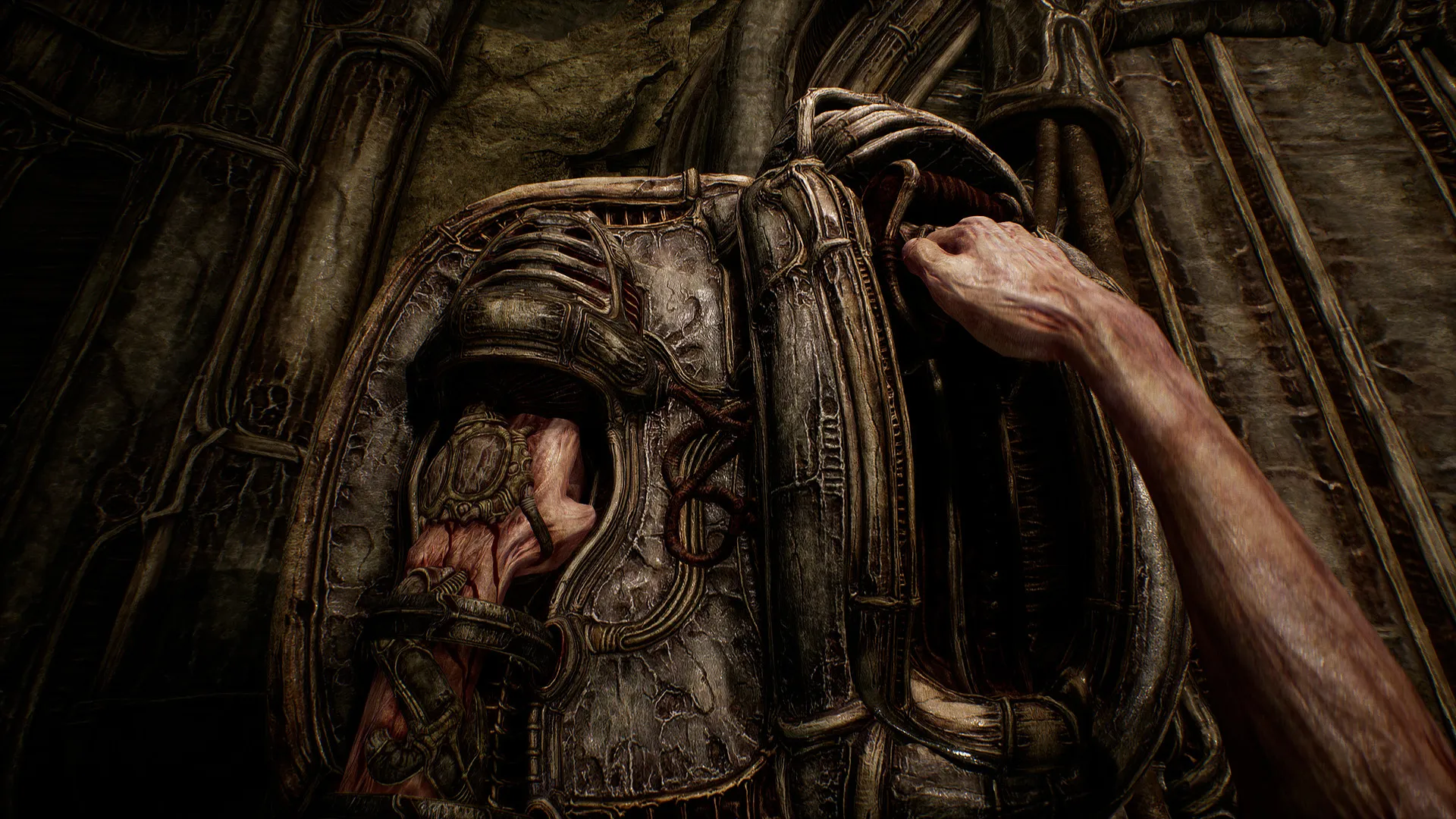
The first and most immediate thing Scorn gets right is world design. The environments are not merely backgrounds for puzzles and combat. They are the game’s central language. Every corridor, chamber, mechanism, and surface communicates something about the world’s logic. That logic is revolting, intimate, and deeply biological.
Walls appear grown rather than built. Doors open like wounds. Devices must be inserted into, twisted through, or activated by parts that resemble organs, vertebrae, tendons, or exposed cartilage. Even stillness feels alive. The world looks as though it is in a permanent state of decay and reproduction at the same time.
Biomechanical horror as total identity
Many horror games borrow pieces of body horror for specific enemies or scenes. Scorn makes body horror the foundation of the entire universe. It does not separate architecture from anatomy. Machines are not metal objects surrounded by flesh. They are flesh functioning as machines.
That is what gives the game its unique tone. There is no safe neutral space. No ordinary room. No area that feels clean, rational, or merely practical. Every inch of the world suggests life twisted into structure and structure twisted back into suffering.
The influence of grotesque art
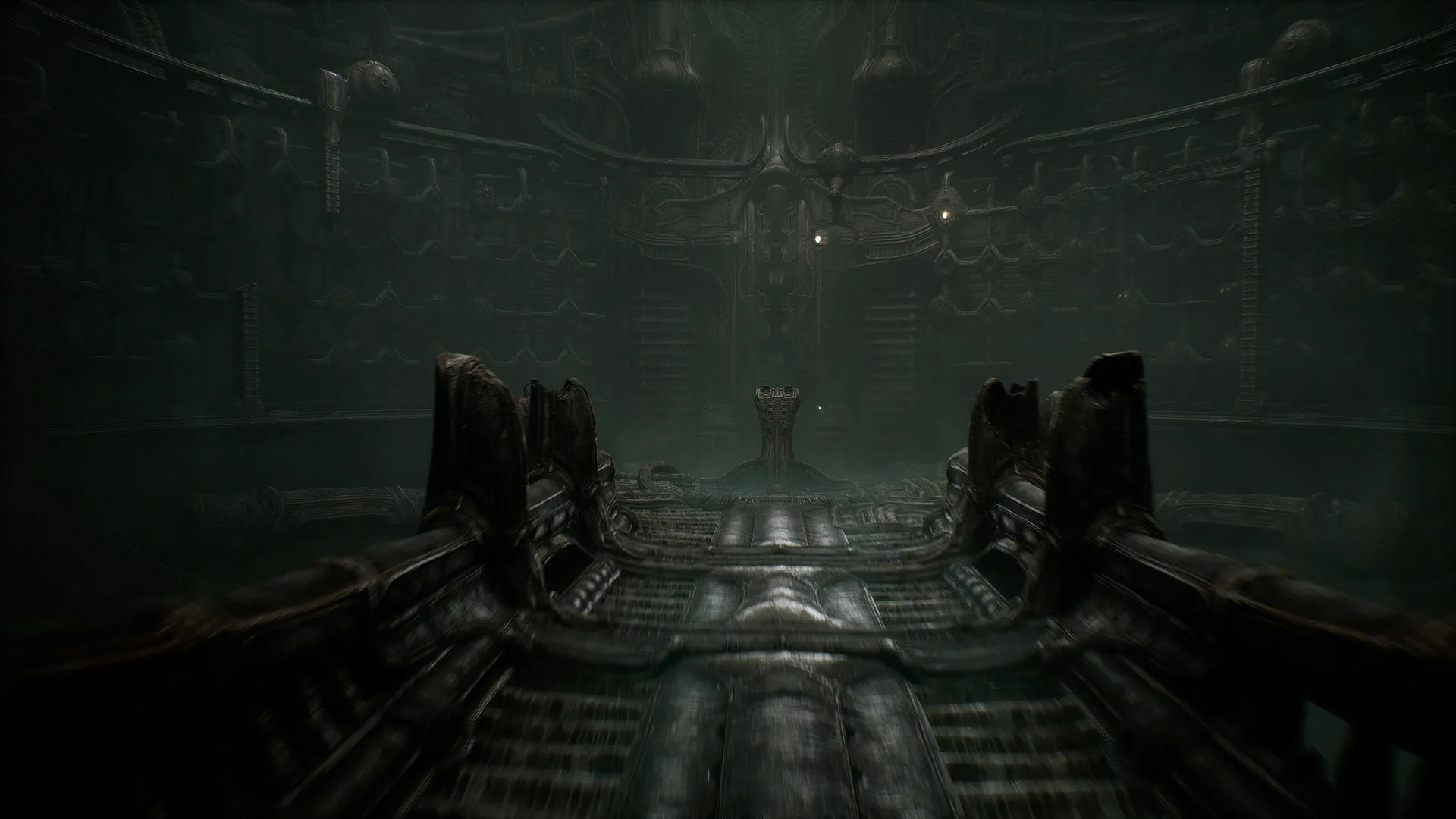
The game’s art direction clearly draws power from surreal and biomechanical horror traditions. Its forms feel sculptural, as if every hallway and mechanism has been carefully shaped to evoke discomfort. The emphasis on bone-like frames, tubular organic shapes, and soft exposed surfaces creates a world that feels ceremonial as well as decayed.
The result is not just ugliness. It is a kind of dreadful beauty. Scorn understands that horror becomes more potent when it feels deliberate, crafted, and complete.
Silence, Isolation, and the Refusal to Explain
Scorn does not guide the player gently
One of the boldest things Scorn does is refuse to explain itself in conventional ways. There are almost no direct narrative handholds. No steady stream of dialogue. No clear exposition dump telling you what happened, who you are, or what your purpose is. Instead, the game leaves players alone with sensation and space.
That can be frustrating for some players, but it is central to the experience. Scorn wants uncertainty to be part of the horror. The player is not a tourist learning about a strange world from a safe distance. The player is lost inside it.
Why the silence matters
Silence in Scorn is not empty. It is oppressive. Ambient sounds of wet movement, distant machinery, and subtle breathing-like vibrations create constant unease. Without explanatory chatter, the player becomes more aware of every scrape, throb, and mechanical shift.
This silence does several things at once:
- it isolates the player emotionally
- it makes the environment feel older and more unknowable
- it forces attention onto visual detail
- it makes every interruption feel important
In many horror games, sound is used to shock. In Scorn, sound is often used to trap the player in a state of prolonged discomfort.
Puzzle Design as Ritual and Violation
Puzzles are part of the world’s cruelty
The puzzle design in Scorn is not clean or abstract. It is tactile, invasive, and often unpleasant by intention. Solving problems requires interacting with devices that seem half-medical and half-industrial. The player rarely feels like a clever engineer. More often, the feeling is closer to operating forbidden machinery with incomplete knowledge.
This matters because the puzzles support the world’s identity. In another game, a locked door might be a simple obstacle. In Scorn, unlocking a path often feels like participating in a gruesome ritual.
The physicality of interaction
Many interactions in the game are memorable because of how embodied they feel. You do not just press a switch. You insert, twist, connect, extract, and manipulate objects that seem fused to flesh or dependent on bodily force. This makes progression feel uncomfortable in a way that fits the broader atmosphere.
Even when puzzles are mechanically straightforward, they feel heavier because of presentation. The game understands that interaction itself can be a source of horror.
When confusion becomes part of the tone
Some players found Scorn’s puzzles frustrating, especially early on. That criticism is understandable. The game can be unclear, and its logic is not always immediately readable. But that opacity also supports the game’s emotional goals. The world should not feel intuitive. It should feel ancient, alien, and indifferent.
The strongest puzzle moments are not the ones that merely challenge intelligence. They are the ones that make the player feel complicit in the world’s systems.
Body Horror and the Fragility of the Self
Scorn treats the body as unstable
If there is one theme that runs through every part of Scorn, it is bodily instability. The player-character does not move through the world like a heroic figure mastering external danger. Instead, he seems trapped in a condition of exposure. The body is not a reliable vessel. It can be invaded, fused with machinery, wounded, altered, or reduced.
This creates a very different emotional tone from traditional horror combat games. Fear in Scorn is not simply about death. It is about transformation, contamination, and loss of autonomy.
The body as environment
One of the game’s most disturbing ideas is that bodies and environments are interchangeable. Architecture resembles organs. Devices resemble limbs. Passages resemble cavities. The player is constantly reminded that flesh can become infrastructure and identity can be absorbed into larger systems.
That is why the game feels so intimate even when it is abstract. It does not just show grotesque things. It makes grotesque things feel spatial, functional, and unavoidable.
Violence without catharsis
Violence in Scorn is often ugly rather than exhilarating. Attacks feel awkward, close, and dangerous. Damage feels painful. Animation emphasizes intrusion and strain rather than spectacle. The game avoids making brutality feel empowering for long.
This is a smart tonal choice. It would be easy for such a visually extreme game to tip into absurdity or pulp action. Instead, Scorn keeps returning violence to discomfort and consequence.
Combat and Why It Feels So Uncomfortable
Combat is deliberately restrictive
Combat is one of the most debated parts of Scorn. It is not especially fluid, empowering, or generous. Encounters can feel clumsy, tense, and inefficient. Weapons are strange, limited, and often awkward to use. Ammunition is not abundant. Space is tight. Enemies are disturbing and often difficult to handle cleanly.
For players expecting an action-horror loop, this can feel frustrating. But the discomfort is partly the point.
Why combat resists empowerment
Most horror-action games eventually let players become confident killers. Scorn resists that arc. Even when armed, the player rarely feels in control. Combat is more like struggling through contamination than heroically clearing threats.
That supports the game’s philosophy. This world is not meant to be conquered. It is meant to be endured.
Enemies as extensions of the world
The creatures in Scorn do not feel like random monsters placed into levels. They feel like natural expressions of the environment’s logic. Their forms match the world’s grotesque anatomy. They seem grown from the same source as the corridors and machinery around them.
Because of that, encounters feel less like interruptions and more like the world defending itself through living matter.
Narrative Through Environment Rather Than Dialogue
Scorn tells its story through implication
The story of Scorn is intentionally fragmented. Rather than giving players a clear plot map, the game provides visual clues, symbolic transitions, environmental echoes, and bodily events that suggest a larger cycle of decay, reproduction, and failed transcendence.
This is one of the game’s most interesting strengths. Its story is not really about plot twists or traditional character development. It is about interpretation.
A world after meaning
The game’s setting feels like a civilization that has outlived purpose. There are signs of systems, rituals, and technologies, but not of vitality or progress. Everything seems abandoned yet still functioning. This gives the world an atmosphere of exhausted continuity, as if ancient processes continue long after anyone remembers why they exist.
That creates a haunting philosophical question: what happens when systems survive meaning?
The player-character as participant, not hero
The player-character does not feel like a savior, chosen figure, or explorer solving the mystery of a fallen world. He feels more like another doomed organism moving through machinery too vast and too old to understand. That choice strips the game of heroic comfort.
The effect is powerful. Instead of asking, “How do I win?” the game quietly pushes players toward darker questions:
- What is this world doing to life?
- What does survival even mean here?
- Is escape possible, or only transformation?
The Emotional Power of Disgust
Scorn understands disgust as atmosphere
Disgust is often treated as a brief reaction in games, usually tied to gore or shock moments. Scorn does something rarer. It turns disgust into an entire mood. Players are not just briefly revolted. They are made to dwell in revulsion for hours.
This works because the disgust is not random. It is aesthetic, systematic, and immersive. The game builds consistency between texture, sound, interaction, and movement. Flesh squelches. Machinery pulses. Surfaces appear infected or gestational. Nothing feels clean.
Why this matters
Disgust is powerful because it blurs physical and psychological boundaries. It makes players feel that something is wrong not just in the world, but in the relationship between themselves and the world. That is exactly where Scorn wants the player: too close for comfort.
A Horror Game About Alienation More Than Terror
Scorn is not mainly about jump scares
What makes Scorn endure is that it is less interested in conventional fear than in alienation. It wants the player to feel estranged from environment, body, purpose, and progress. It is horror through existential displacement.
That is why so many of its strongest moments are quiet rather than explosive. Walking through impossible architecture. Using an instrument that looks surgical and reproductive at once. Seeing movement in the walls. Realizing that every mechanism appears to require a living cost.
These moments do not startle. They sink in.
The loneliness of interpretation
Because the game refuses to explain itself fully, players are left alone not only in space but in meaning. You are not just physically isolated. You are interpretively isolated. You must decide what the world suggests, what the symbols mean, and whether there is any hope at all inside its logic.
That loneliness is one of the game’s most haunting qualities.
Why Scorn Divides Players
Its strengths are also its risks
Scorn is the kind of game that strongly attracts one audience while pushing another away. That is almost inevitable. Its atmosphere-first design, cryptic storytelling, and intentionally uncomfortable systems make it more like an immersive art-horror experience than a broadly accessible action game.
Players who want:
- conventional pacing
- clear storytelling
- smooth combat mastery
- regular rewards and guidance
may find it cold or frustrating.
But players who value:
- visual worldbuilding
- oppressive atmosphere
- body horror
- symbolic storytelling
- tactile discomfort as design
often find it unforgettable.
A game committed to its own vision
Whether someone loves or dislikes Scorn, it is hard to argue that it feels generic. It knows exactly what kind of experience it wants to be. That kind of artistic commitment is rare, and it gives the game unusual staying power in discussion.
The Legacy of Scorn
A game remembered for mood and imagery
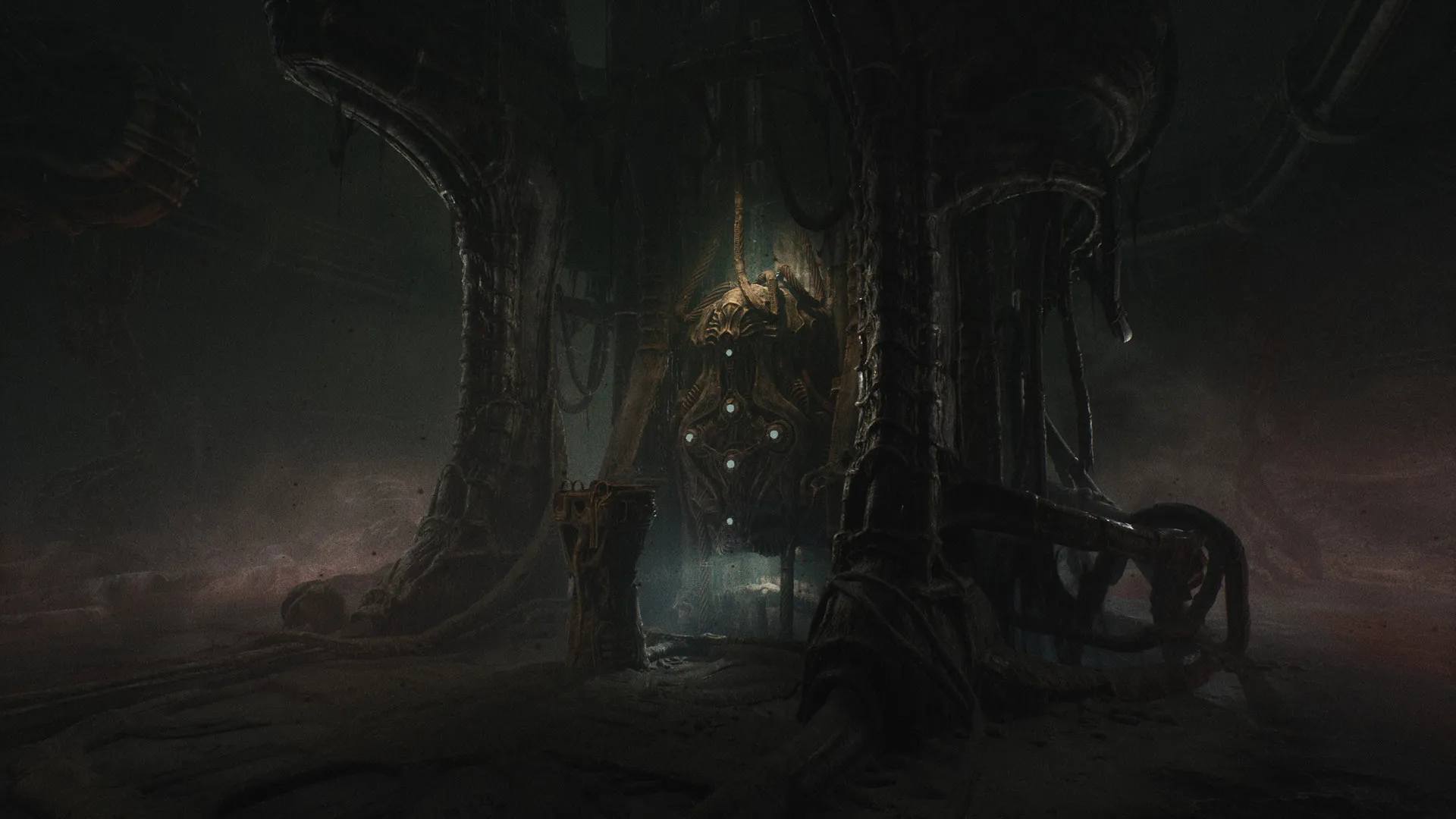
Scorn may not be remembered as the most mechanically polished horror game of its era, but it has already secured a place as one of the most visually and atmospherically distinct. Certain images from it linger in the mind because they feel less like game levels and more like forbidden sculptures the player has walked through.
Its real legacy lies in proving that a horror game can commit almost entirely to environmental identity and still create a deeply memorable experience.
Why players still talk about it
People still talk about Scorn because it leaves residue. Not just narrative questions, but emotional residue. A sense of having spent time somewhere truly hostile to human comfort. A memory of spaces that felt alive in the wrong way. A feeling of vulnerability that was not heroic, just raw.
That kind of impact is hard to manufacture. Scorn achieves it by refusing to soften itself.
Conclusion
Scorn stands apart from most horror games because it does not simply want to scare the player. It wants to envelop the player in a total biomechanical nightmare where every wall, tool, creature, and bodily gesture contributes to a single oppressive vision. Its world is grotesque, silent, invasive, and unforgettable.
The game’s puzzles, awkward combat, and cryptic structure will not work for everyone, and that is part of its identity. Scorn is not trying to be universally comfortable or conventionally satisfying. It is trying to create a sustained experience of alienation, disgust, and bodily unease. On that level, it succeeds with unusual force.
What remains after playing Scorn is not the thrill of victory or the neat satisfaction of solved mystery. It is something stranger: the memory of having wandered through a world where flesh had become architecture, machinery had become ritual, and existence itself felt trapped inside a monstrous design.