.webp)
My Talking Tom Friends 2: How Needs and Wishes Become the Game’s Core Gameplay Loop
My Talking Tom Friends 2: How Needs and Wishes Become the Game’s Core Gameplay Loop
Introduction
At first glance, My Talking Tom Friends 2 appears to be another colorful virtual-pet game built around feeding cute characters, dressing them up, decorating houses, and playing small activities. That description is accurate, but it misses the more interesting design decision underneath the surface. The game is structured around a very specific loop: each character develops needs and wishes, the player interprets those requests, the neighborhood provides the tools to satisfy them, and completing those actions produces progression through hearts, rewards, new activities, and additional customization.
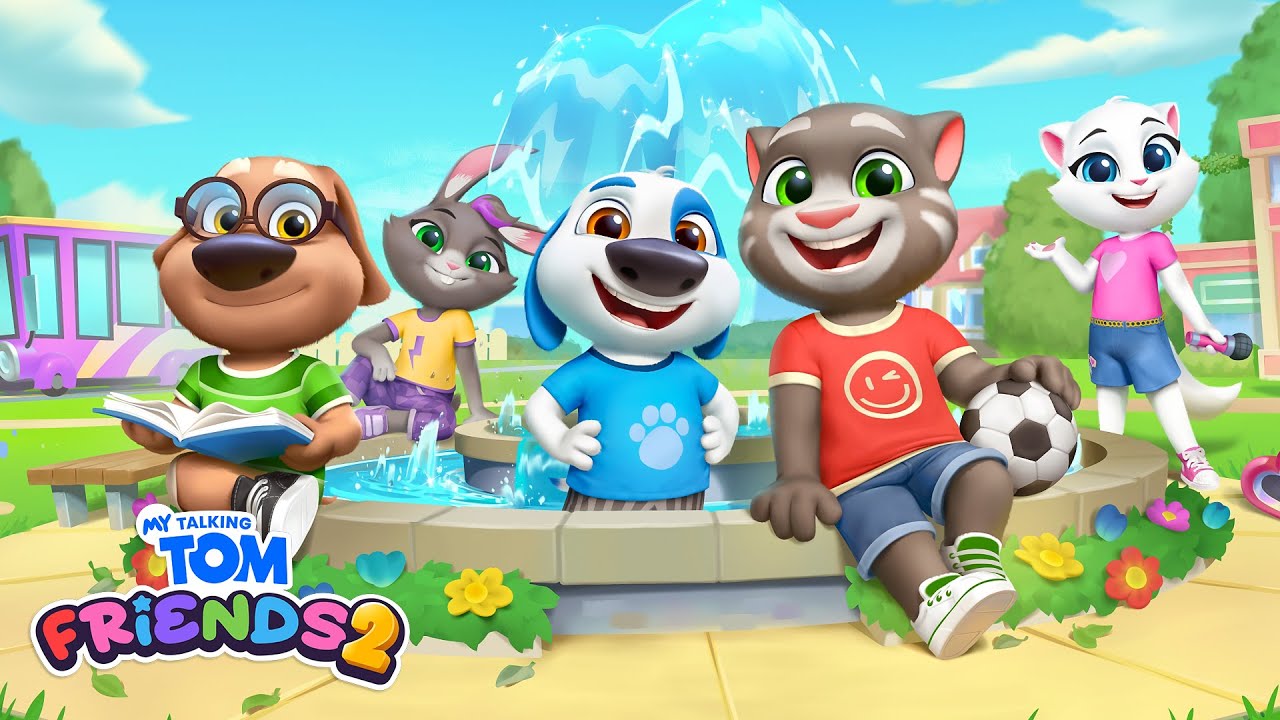
This system is especially important because My Talking Tom Friends 2 does not place all of its characters in one shared home. Instead, Tom, Angela, Hank, Ben, and Becca each have their own spaces, personalities, and activities, while the surrounding neighborhood contains locations such as the food store, clothing shop, health center, greenhouse, and park. Outfit7 has described this neighborhood structure as a way to make the characters feel more individual and give players more opportunities for interaction and storytelling.
The result is a game in which the player is rarely asked to complete a traditional mission. There is no conventional campaign telling the player to defeat a villain or reach a final destination. Instead, the game constantly creates small situations that need attention. A character becomes hungry. Another wants to play music. Someone wants a new outfit. Another character may want to sleep, participate in an activity, or interact with an object.
Those small requests are the real engine of the experience.
The interesting question, therefore, is not simply what players can do in My Talking Tom Friends 2. It is how the game turns ordinary actions—feeding, playing, cleaning, dressing, decorating, and socializing—into a continuous progression system. The following analysis focuses specifically on that mechanism and why it makes the neighborhood feel more active than a collection of disconnected mini-games.
1. The First Interaction Establishes the Needs-and-Wishes Loop
The most important design decision happens before the player has explored most of the neighborhood. Characters communicate what they want through visual requests, giving the player an immediate problem to solve. A thought or speech bubble can indicate a desired activity or object, and satisfying those wishes contributes to progression. Guides for the game describe hearts as a central progression indicator, with players earning them by helping characters fulfill needs and wishes.
This creates a very different opening from a traditional game tutorial. Instead of teaching the player through a long sequence of instructions, the game effectively says: look at your friend, figure out what they want, and help them.
The request becomes the mission
A character asking for food does not merely create a cosmetic animation. It sends the player toward another system.
If Tom wants something to eat, the player may need to find food. That can lead to the picnic table or the supermarket. If Angela wants a particular activity, the player may need to take her to an appropriate location. If another friend wants entertainment, the player can search for an object or mini-game that satisfies the request.
The important part is that the request creates movement.
The character generates the reason to explore the environment.
Why this matters
Without the needs-and-wishes system, the neighborhood could easily become a collection of attractive rooms that the player visits once and forgets.
Instead, the game constantly gives the player reasons to return to those spaces.
A supermarket is no longer simply a shop.
A picnic table is no longer simply decoration.
A guitar is no longer simply an interactive object.
Each becomes part of a response system.
The player's job is to connect the character's request with the appropriate object or activity.
That simple relationship becomes the foundation for almost everything that follows.

2. The Neighborhood Turns Requests into Physical Objectives
Once a character expresses a desire, My Talking Tom Friends 2 makes the player physically move through the neighborhood to fulfill it. This is one of the game's most important differences from a conventional virtual-pet interface.
The world is designed so that the answer to a character's request often exists somewhere else.
The official game description highlights locations such as a food market, clothing shop, park, and individual character homes, while other sources describe additional facilities including a plant nursery and health center.
From menu selection to exploration
Imagine a character wants food.
A conventional virtual-pet game might simply present a food icon on the screen.
Here, food can become a miniature activity. The player can travel to the supermarket, select products, place them into a cart, and then use the purchased items elsewhere.
This adds physicality to what would otherwise be a simple stat-management mechanic.
The same principle applies to other systems.
A desire for clothing leads toward the clothing store.
A desire for gardening leads toward the nursery.
A desire for entertainment may lead toward a character's house or the park.
The neighborhood becomes a problem-solving map
This means the game's map is not primarily about distance.
It is about relationships.
The player learns:
- Which place provides food.
- Which house contains a particular activity.
- Which character prefers particular forms of entertainment.
- Which objects can satisfy certain requests.
- Which locations produce useful rewards.
- Which activities are worth revisiting.
The player is therefore gradually building a mental map of the neighborhood.
That is an important distinction because the game does not need traditional quests to make its world useful. The characters themselves generate the reasons for visiting it.
3. Character Personalities Give the Same Loop Different Meanings
A potential weakness of a needs-based system is repetition. If every character simply becomes hungry, tired, or bored in exactly the same way, the player may begin treating them as identical meters.
My Talking Tom Friends 2 attempts to avoid this by emphasizing individual personalities and spaces. Outfit7 specifically describes each character as having their own home, personality, voice, and style.
This matters because the game's central loop is repetitive by design.
The solution is not to eliminate repetition.
It is to make repeated actions feel different depending on who is involved.
Five characters, five spaces
Tom's home is presented as a music-oriented loft.
Angela has an art studio.
Hank has a more comfortable, creature-focused environment.
Ben has a gadget-oriented garage.
Becca has a technology-focused space.
The official descriptions emphasize that these locations are designed around the characters' identities rather than functioning as interchangeable rooms.
Personality becomes gameplay context
This means the character is not merely an animated avatar placed inside a room.
The room tells the player something about the character.
The activities reinforce that impression.
Tom's musical activities make him feel different from Ben's technological experiments. Angela's artistic environment provides another identity, while Becca's technology-oriented room creates another.
The same basic design principle appears repeatedly:
character identity → personal space → interactive objects → player activity.
That chain gives the needs-and-wishes system more personality than a generic virtual-pet meter.
4. Fulfilling a Wish Creates a Small Reward Cycle
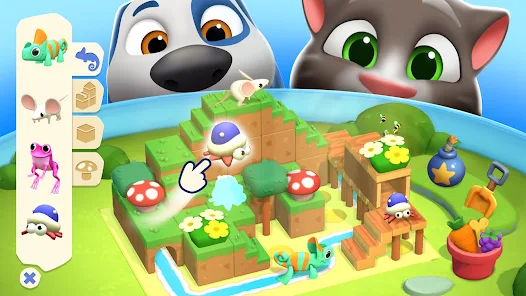
After the player identifies and satisfies a request, the game provides progression feedback. Hearts are particularly important because they function as a visible representation of progress toward the next level. According to gameplay guides, filling the heart meter advances the player and can unlock new features, props, games, or even additional friends and homes.
This turns an apparently trivial action into something meaningful.
Feeding a character is not just feeding.
Playing music is not just playing music.
Changing an outfit is not just cosmetic.
Each action can contribute to a larger progression loop.
The small-action philosophy
The game is built around tiny accomplishments.
A player might complete one request in less than a minute.
Then another.
Then another.
Individually, these actions are extremely simple.
Together, they create a continuous rhythm:
Need → action → satisfaction → reward → progression → new need.
That rhythm is the actual gameplay loop.
Why hearts are important
Without a progression reward, the player would have little mechanical reason to continue fulfilling needs after the novelty of the characters wears off.
Hearts solve that problem.
They give ordinary interaction a measurable consequence.
The player begins to associate successful care with progress.
This also means that the game's progression does not require traditional combat, puzzles, or narrative missions. The player's relationship with the characters itself becomes the source of advancement.
5. Nighttime Changes the Meaning of the Daily Routine
The needs-and-wishes system becomes particularly interesting because the game is not entirely static. A day-night cycle is part of the neighborhood structure, and characters can continue contributing to progression while sleeping. Guides describe hearts being earned during the night once friends have gone to bed, allowing progress to continue until morning.
This creates an unusual relationship between active and passive play.
During the day, the player actively solves problems.
At night, the game creates the impression that the characters continue existing without constant supervision.
A simulated routine
This makes the characters feel less like objects waiting for commands and more like inhabitants of a small simulated community.
Morning creates a reset of sorts.
The player returns to the neighborhood.
Characters have new needs.
New requests appear.
The player responds.
Eventually, the characters sleep again.
This creates a repeated daily rhythm.
Why the night cycle matters
The day-night structure is not merely visual decoration.
It reinforces the central fantasy of caring for a group of friends.
The player is not completing a fixed campaign.
The player is maintaining a little world.
That distinction explains why small activities can remain meaningful even when they are mechanically simple.
The goal is not mastery in the traditional sense.
The goal is participation in the routine.
6. Mini-Games Work Because They Are Attached to the Characters
My Talking Tom Friends 2 contains a large variety of mini-games, including football, basketball, racing, spray painting, paper-plane activities, lawnmower racing, music, and other interactive challenges.
On their own, these mini-games could easily feel like unrelated additions.
The needs-and-wishes system gives them a reason to exist.
The mini-game is an answer
A character can want to play.
The player then chooses an activity.
The activity provides entertainment.
The character's need is satisfied.
The player receives progression.
This makes the mini-game function as part of the broader care system rather than as an isolated arcade mode.
The importance of variety
The activities also help prevent the daily-care loop from becoming monotonous.
A player might move between:
- Football practice.
- Basketball.
- Racing.
- Music performances.
- Spray-paint activities.
- Paper-plane challenges.
- Gardening.
- Shopping.
- Health-center interactions.
The variety does not necessarily make every activity deep.
Instead, it changes the texture of the routine.
That is exactly what a game based on repeated care requires.
The player does not need every activity to become a complex standalone game.
The activities simply need to provide enough variation to keep the basic loop from becoming completely predictable.
7. Houses Turn Customization into an Extension of Character Identity
Customization could have been implemented as a purely cosmetic feature, but My Talking Tom Friends 2 connects decoration with the game's character-focused structure.
The official store description highlights hundreds of decorations and emphasizes that each character has a distinct home that players can customize.
This means decoration serves two purposes.
First, it provides self-expression.
Second, it strengthens the player's relationship with individual characters.
Decorating a character's identity
Changing a room changes the visual environment in which the character exists.
If Tom's room is redesigned, the player is not merely changing a piece of scenery.
The player is effectively deciding what Tom's personal space should look like.
The same applies to Angela, Hank, Ben, and Becca.
This creates a connection between customization and ownership.
From caring to creating
The needs system tells the player:
“Your friend needs something.”
The customization system asks:
“What kind of world do you want your friend to live in?”
Those are different questions.
One is responsive.
The other is creative.
Together, they prevent the experience from becoming purely reactive.
The player is not only responding to the characters.
The player is also shaping their environment.
8. The Shopping and Gardening Systems Expand the Loop Beyond Basic Care
The neighborhood's supporting systems are particularly useful because they turn simple needs into small chains of interaction.
The supermarket, for example, is not merely a menu for selecting food. Guides describe the player physically selecting products and placing them into a shopping cart before using them at the picnic area. The plant nursery similarly involves planting, watering, fertilizing, and eventually moving grown plants into the neighborhood.
A need can become a process
Consider hunger.
The simplified version is:
Character hungry → give food → character satisfied.
But the neighborhood can turn that into:
Character hungry → visit supermarket → select food → shop → return → feed character → earn reward.
The additional steps are not complicated.
They are meaningful because they create a sense of activity.
Gardening uses the same principle
Gardening goes even further.
A seed needs to be planted.
The plant may need water.
It may require fertilizer.
Eventually it grows.
Then it can become part of the neighborhood.
This is a miniature progression system contained inside the larger progression system.
The player is therefore managing several overlapping loops:
Character care
Neighborhood activities
Resource acquisition
Decoration
Progression
The important thing is that these systems are not completely isolated.
They feed into each other.
9. New Content Keeps the Loop From Becoming Static
One reason the needs-and-wishes structure can continue working over time is that the game has continued adding activities and features after launch. The App Store version history records expanded mini-games, new neighborhood activities, a cinema feature, cooking content, and other additions.
This is significant because a life-simulation game has a difficult problem to solve.
Its basic actions are inherently repetitive.
Characters will always need food.
They will always need entertainment.
They will eventually sleep.
They will need attention again.
If the available responses never change, the routine can become predictable.
New activities refresh old needs
Adding a new cooking activity, for example, does not necessarily require inventing an entirely new purpose for the game.
The fundamental need remains the same:
A character wants food.
But the way the player responds can become more elaborate.
The same principle applies to new mini-games.
The need to have fun remains.
The available ways to satisfy it expand.
Content is therefore layered onto the core loop
This is a particularly efficient structure.
Instead of rebuilding the game every time new content arrives, developers can attach new activities to an existing system.
The player already understands the basic relationship:
Character wants something → find an activity → interact → satisfy the character → receive progression.
New content simply increases the number of possible answers.
That makes the neighborhood increasingly useful without fundamentally changing the game's identity.
10. The Real Progression Is Learning How the Neighborhood Works
After enough time with My Talking Tom Friends 2, the most significant progression is not necessarily the number of decorations owned or mini-games completed.
It is the player's growing understanding of the characters and their environment.
At the beginning, the neighborhood is unfamiliar.
The player has to experiment.
Where does the food come from?
Which activities does each character enjoy?
What is inside each house?
What does a particular request mean?
Which objects are interactive?
Over time, these questions disappear.
The player develops routines.
From guessing to anticipating
This is where the needs-and-wishes system becomes more interesting than it initially appears.
Early on, the player reacts.
Later, the player anticipates.
If a character is hungry, the player already knows where to go.
If someone wants entertainment, the player remembers several suitable activities.
If a character needs something from another location, the player can navigate there without experimentation.
The neighborhood becomes mentally organized.
The player becomes part of the routine
Eventually, the experience can feel less like solving individual requests and more like managing a small community.
The player understands the rhythm:
- Check the characters.
- Read their requests.
- Decide which need to handle first.
- Travel to the appropriate location.
- Perform the activity.
- Collect the reward.
- Repeat.
- Eventually prepare the friends for rest.
- Return later to begin another cycle.
That is the game's real structural achievement.
The individual actions are simple.
The system connecting them is what gives them meaning.
Conclusion
The most important feature of My Talking Tom Friends 2 is not any single mini-game, costume, house, or character animation. It is the way the game connects all of those elements through the needs-and-wishes system.
A character expresses a need.
The player interprets it.
The neighborhood provides a destination.
An interactive object or activity provides the solution.
The character responds.
The player receives progression.
Then another need appears.
That cycle sounds extremely simple, but it explains why the game's many apparently unrelated features fit together. The supermarket exists because characters need food. The picnic area exists because food needs somewhere to be used. The clothing store exists because characters can be customized. The individual homes exist because each character has a distinct identity. The mini-games exist because characters need entertainment. The garden exists because the neighborhood can provide another layer of interaction.
The game is therefore less like a collection of mini-games and more like a network of answers to character requests.
That is also why the sequel's neighborhood structure matters so much. Outfit7 deliberately moved away from having the entire cast share one house and instead gave characters their own homes and stronger individual identities. The result is a world where the player's relationship with each character can feel slightly different even though the underlying systems remain connected.
The progression system reinforces this design. Hearts turn ordinary acts of care into measurable advancement, while new features, props, activities, and characters give players reasons to continue interacting with the world.
Most importantly, the game's repeated daily routine does not depend on dramatic objectives. It depends on small moments.
Someone is hungry.
Someone wants to play.
Someone wants a new outfit.
Someone wants to visit an activity.
Someone wants attention.
The player responds.
That is the heart of My Talking Tom Friends 2.
Its central design idea is not that the player controls five characters. It is that the player is continuously responding to a small community of characters whose needs generate reasons to explore the world.
And once the player understands that system, the neighborhood stops feeling like a collection of colorful locations.
It becomes a machine for producing little stories.
A trip to the supermarket becomes part of a character's routine.
A football game becomes a shared activity.
A customized bedroom becomes an expression of personality.
A cooking session becomes a social moment.
A nighttime sleep cycle becomes the conclusion of another day.
None of these actions is particularly complex on its own.
Together, however, they create the illusion of a living neighborhood.
That is the specific strength of My Talking Tom Friends 2: it takes the repetitive mechanics of virtual-pet care and connects them to exploration, customization, mini-games, character identity, and progression so tightly that the entire neighborhood becomes one interconnected response system.
The player does not advance because the world gives them a traditional quest.
The player advances because the characters keep giving them reasons to care.
110-character summary:
My Talking Tom Friends 2 turns daily care into a social loop built around needs, wishes, and shared play.